


A recent public opinion poll by Pew Research found that only about half of Americans believe climate change is primarily caused by human activities, and that percentage has not changed much over the past decade. About one in five believe climate change is mainly the result of natural cycles, while the remainder either do not see convincing evidence or are unsure.
An earlier public opinion survey of the global top 15 emitters of greenhouse gases (GHGs) had shown that only 34 percent of Americans are alarmed by climate change compared to for example Mexico where 64 percent of population expressed being alarmed by climate change, placing the United States 13th out of 15 countries. The gap between scientific consensus and public opinion is striking. To understand why that gap matters, it helps to first understand how greenhouse gases warm the planet and why scientists are so confident that human activities are driving today’s rapid climate change.
How Greenhouse Gases Warm the Earth
The primary greenhouse gases are carbon dioxide (CO₂), methane (CH₄), nitrous oxide (N₂O). These gases act like an insulating blanket around the planet.
The Earth absorbs energy from the sun and then releases much of that energy back toward space as infrared radiation (heat). Greenhouse gases absorb some of this outgoing heat and re-radiate it in all directions, including back toward Earth’s surface. This natural greenhouse effect makes life possible by keeping the planet warm enough to support life.
The problem is that human activities—primarily burning of coal, oil, and natural gas, along with deforestation and some agricultural practices—have dramatically increased the concentration of greenhouse gases in the atmosphere. The more greenhouse gases we add, the more heat is trapped, causing the planet to warm.
Why American Public’s Low Level of Concern Matters
The relatively low level of concern among the American public shows a lack of awareness about the country’s role in creating today’s climate crisis.
The United States is not only the second largest emitter of greenhouse gases after China and one of the largest per capita emitters, but it is also responsible for roughly one-fourth of the total carbon dioxide that has accumulated in the atmosphere since the Industrial Revolution, higher than, for example, the twenty-eight countries that make up the European Union.
Moreover, the fact that public opinion has changed so little over the past decade is especially troubling for two reasons. First, scientific evidence overwhelmingly shows that human activities are the primary driver of today’s rapid climate change. Second, the effects of that warming are becoming increasingly visible in our everyday lives.
Scientific Evidence
Temperature records from around the world date back to the early 1700s, with more systematic global measurements beginning in mid-1800s. Together, these records show a clear and sustained increase in Earth’s average temperature. Since the late 1800s, Earth’s average surface temperature has increased by approximately 1.3 - 1.4 C. This warming has closely paralleled the rapid rise in CO2 concentration in the atmosphere due to human-generated emissions.
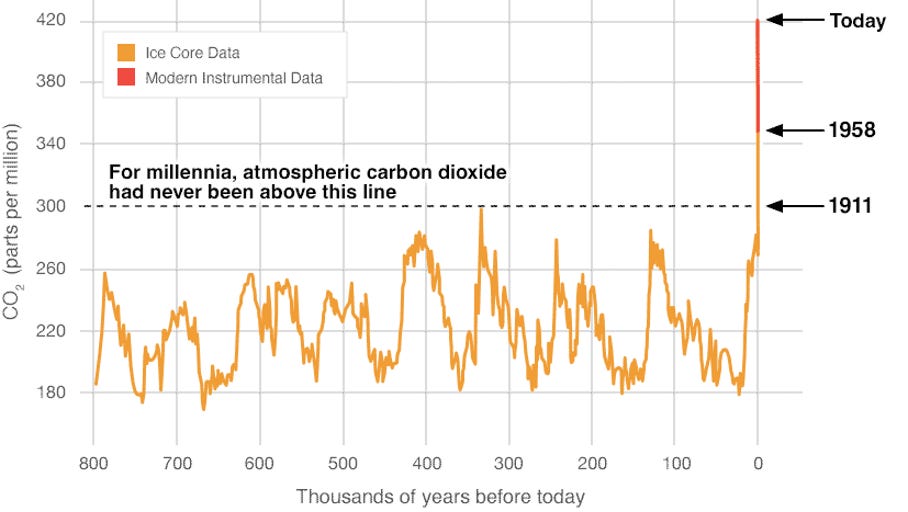
Atmospheric CO₂ concentrations were less than 280 parts per million (ppm) in 1750. By 2024 the CO2 concentrations had risen to more than 420 ppm. Climate scientists generally regard 350 ppm as the upper limit for maintaining a relatively stable climate.
Perhaps the strongest evidence of humanity’s influence comes from Earth’s climate history. Tiny air bubbles trapped in Antarctic and Greenland ice cores preserve samples of ancient atmospheres stretching back 800,000 years. Those records show that atmospheric CO₂ never exceeded 300 ppm during that entire period—until the modern industrial era.
Climate Change Is Already Reshaping Our World
Rising temperatures do not occur in isolation. They trigger a cascade of changes throughout Earth’s climate system. They are reshaping water supplies, coastlines, and weather patterns around the world.
Heatwaves and Water
The past decade has been the warmest on record. In cities across the United States, the average rate of extreme heat events increased from two per year in the 1960s to six per year between 2010 and 2020. Additionally, the average length of heatwave season in the U.S. has increased by 46 days since the 1960s. At the same time, droughts have become longer and more severe. In western United State the average dry period between storms increased from about 30 days in the 1970s to 45 days in 2024 and compared to the 1948–1999 period, the size of areas affected by drought increased by 17 percent between 2000 and 2022.
Freshwater supplies are also under increasing pressure. Rising temperatures, declining snowpacks, shrinking glaciers, and greater evaporation have reduced the amount of water stored in rivers and reservoirs. In the American Southwest, where the Colorado River provides water to roughly 40 million people across seven states has experienced repeated shortages that have triggered political disputes and emergency water restrictions.
Sea Level Rise
Sea levels are rising as glaciers and the massive ice sheets in Greenland and Antarctica melt and as warmer seawater expands. Global sea level has risen by approximately 8 to 9 inches since 1880 with about half of that increase occurring in the past three decades. Many coastal communities now experience chronic flooding during high tides and are spending billions of dollars to build seawalls, elevate roads, or relocate homes and infrastructure.
More Extreme Weather
Since 1970 the number of wildfires in the western United States has increased by more than 400 percent. The total area burned has increased by more than 600 percent, and the wildfire season has lengthened by approximately two months.
Hurricanes have also become more intense and therefore more destructive. Compared with the 1970s, there are now roughly twice as many category 4 and 5 hurricanes. Storms are more likely to undergo rapid intensification, and the Atlantic hurricane season has lengthened by nearly two weeks since the mid-1990s.
Taken together, these trends tell a remarkably consistent story. Heat waves, droughts, wildfires, and more powerful hurricanes have all become more frequent over the past several decades, while the time between many extreme events has grown shorter.
What We Must Do
The evidence that human activities are driving climate change has never been stronger. The real question is no longer whether the climate is changing, but how quickly we are willing to respond. Every year of delay increases the economic, environmental, and human costs.
Becoming informed is the first step. Acting on that knowledge is the next. We must read the science. Examine the data. Compare claims with evidence from trusted scientific organizations. We must talk about the evidence with family and friends, and support policies and businesses that reduce greenhouse gas emissions.
The choices we make as voters, consumers, business executives, and community members will help determine the climate we leave to the next generation.