


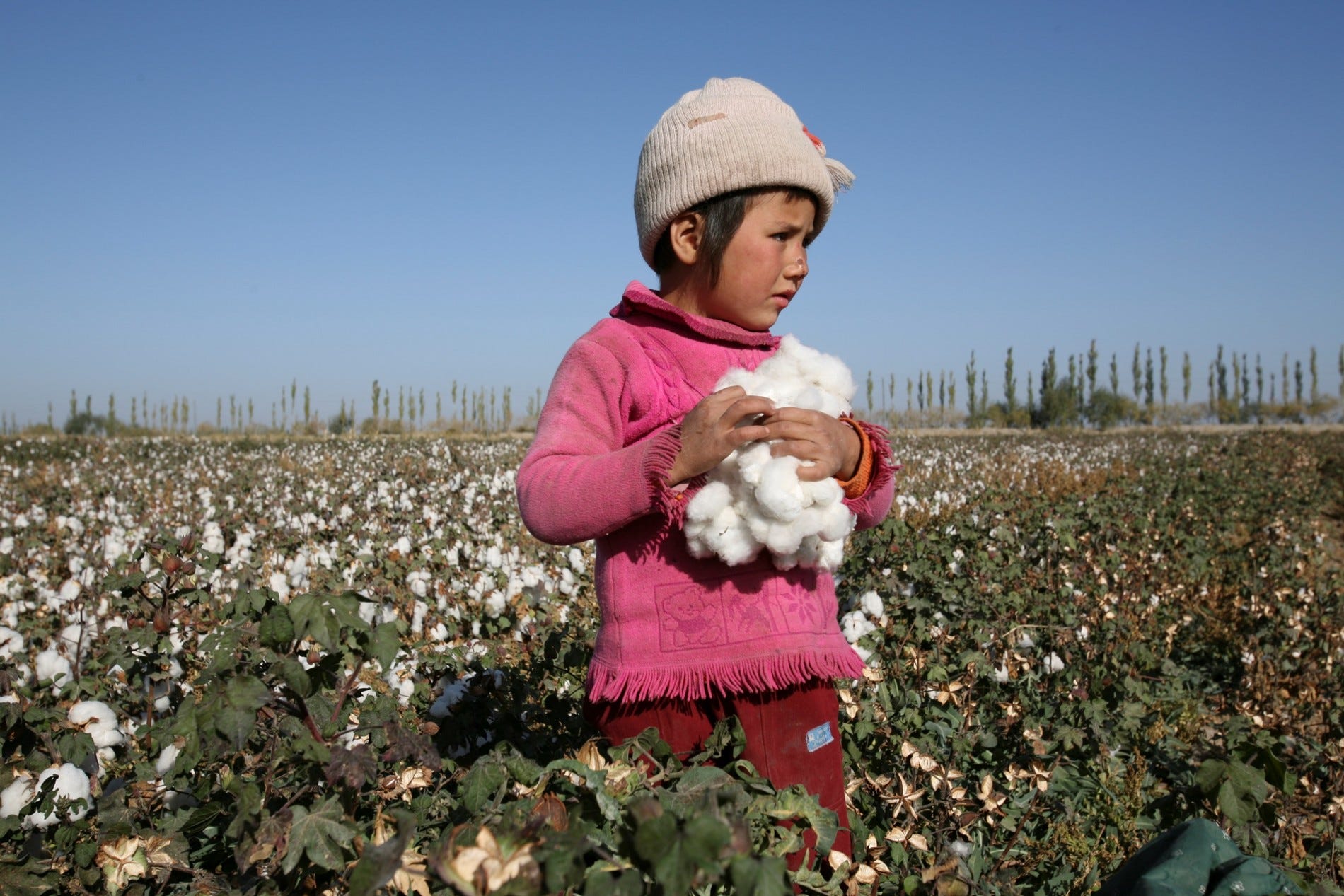
The global garment industry produces billions of cheap, disposable pieces of clothing every year. This industrial-scale production not only inflicts severe damage on the environment but also exploits some of the world’s most vulnerable people—mostly poor women and children.
Environmental Damage
The fashion industry’s environmental toll is staggering. Its production systems are eroding the very natural foundations on which our future depends.
Carbon emissions: The garment industry is responsible for 10% of global carbon emissions—more than all international flights and maritime shipping combined. At the current rate of growth, it could produce one-fourth of all emissions by 2050, the very year humanity aims to reach net-zero emissions.
Water use: Fashion is the second-largest consumer of water in the world, using an estimated 215 trillion liters (50 trillion gallons) annually.
Chemical pollution: It consumes 25% of the world’s chemicals and produces 20% of global industrial wastewater. The dyeing process alone uses enough water each year to fill 2 million Olympic-sized swimming pools—and much of that toxic water is dumped directly into rivers and streams.
Cotton’s hidden cost: Cotton is often seen as a “natural” alternative to polyester, but it is far from environmentally neutral. Producing one cotton shirt requires 700 gallons of water, enough for one person to drink eight cups a day for three and a half years. Cotton cultivation consumes 16% of all insecticides and 7% of all herbicides used worldwide.
Labor Exploitation
Behind the low prices of fast fashion lies a hidden workforce enduring dangerous and dehumanizing conditions.
Rana Plaza collapse in Bangladesh on April 23, 2013 was only the worst example of poor working conditions in the garment industry. It killed 1,132 and injured more than 2,600 garment workers making clothes for U.S. and Canadian retailers. Following public outrage, 222 companies signed the Accord on Fire and Building Safety in Bangladesh, a legally binding agreement to ensure safer workplaces.
By 2019, however, of 4,600 factories, only 1,690 met fire and building safety standards—a reminder of how far the industry still has to go.
According to the nonprofit Remake, the garment industry directly employs 75 million people, 80% of whom are women aged 18 to 24. Alarmingly, 14% report physical or sexual violence at work.
The U.S. Department of Labor has found evidence of both forced and child labor in garment production. In Bangladesh, for instance, workers earn about $96 per month, while the government’s wage board estimates that they need 3.5 times that amount to live a “decent life with basic facilities.”
This exploitation isn’t confined to developing countries. In Eastern Europe garment workers are paid one-fifth to one-third of the living wage. In the United States, undocumented workers produce clothes for major brands, working 60-hour weeks in rat infested factories in Los Angles. When their wages are not stolen by the employer they make around $5 an hour. Yet their products carry the reassuring label “Made in USA,” misleading consumers into believing they were ethically produced.
The harsh reality of exploitation and deception sets the stage for another troubling trend in the fashion industry—the rise of so-called “sustainable” branding that often conceals more than it reveals.
Sustainable Sourcing and Materials
Brands increasingly market their products as “sustainable,” yet few provide evidence to support those claims. According to Fashion Revolution, most companies remain opaque about their environmental and social practices:
Only 46% publish sustainable sourcing targets
37% define what “sustainable materials” actually mean
24% disclose how they minimize microfibre pollution
A mere 11% publish supplier wastewater test results
Only 29% have decarbonization targets that include their supply chain
Transparency remains the exception, not the rule:
52% of major brands disclose no information about their supply chains
96% do not report how many workers earn a living wage
Just 13% disclose how many supplier facilities have trade unions
94% do not report on gender-based labor violations
Only 3% reveal their ethnicity pay gap, and 8% disclose initiatives on racial or ethnic equality
Meanwhile, oil industry continues to fuel fashion’s synthetic addiction. Between 2012 and 2019, it financed 88 new petrochemical projects, further expanding the use of synthetic fibers which have doubled since 2000. Today, two-thirds of all garments are made from fossil-fuel-based synthetics.
What Can Consumers Do?
Change begins with rethinking our relationship to fashion.
A 2020 OnePoll survey of 2,800 Americans found that while 69% expressed concern about environmental issues:
48% said they prefer not to be photographed in the same outfit twice.
46% felt they couldn’t be both stylish and eco-friendly.
54% prioritized affordability over quality.
Only 44% said they often consider the environmental impact of their clothing purchases.
44% admitted to throwing out perfectly good clothes.
These contradictions reveal a deeper issue: we buy far more than we need. The average American purchased 60% more garments in 2024 than in 2000. In Europe, fashion companies increased their collections from two per year in 2000 to five by 2011. Some brands, foe example, Zara, release 24 collections per year. H&M releases between 12 and 16 collections. Yet 85% of major brands do not disclose their production volumes.
Every purchase has a cost—often one we don’t see. Asking ourselves a simple question before buying can make a difference:
Do I really need this?
Buying less also means polluting less. Washing clothes releases 500,000 tons of microfibers into the ocean each year, the equivalent of 50 billion plastic bottles. Polyester, found in 60% of garments, emits 2–3 times more carbon than cotton and never breaks down in the ocean.
In the End
Our wardrobes tell a story—not just about our style, but about our values. Every shirt, every pair of jeans, every impulse buy carries a hidden cost, often paid by someone poor, somewhere far away.
Living more sustainably means recognizing that what we wear can either contribute to exploitation and environmental destruction—or become part of the solution.
We can start by buying less, choosing better, repairing what we own, and supporting brands that treat people and the planet with respect. What we wear, after all, is not just fashion. It’s a reflection of who we are.