


For decades, politicians from both major U.S. political parties have accepted campaign contributions from the fossil fuel industry. Since 1990, the numbers have been strikingly similar: 781 Democratic senators and 3,427 Democratic House members, compared to 857 Republican senators and 3,774 Republican House members.
However, over time, the fossil fuel industry's support has shifted increasingly toward Republicans. In 1990, donations favored Republicans by a 2-to-1 margin. By 2024, that ratio had grown to 8-to-1.
This growing imbalance in contributions helps explain the widening partisan divide on climate policy. Democrats have generally shown more support for clean energy and climate action, while Republicans have become the political home for climate denial.
Yet, despite promoting renewable energy initiatives, Democratic administrations as well as Democrats in Congress have advanced fossil fuel interests. This contradiction has significantly undermined the United States’ ability to phase out fossil fuels and implement the long-term adaptation measures required to address the climate crisis.
The Obama and Biden Administrations
President Barack Obama oversaw major renewable energy investments, but his administration also supported fossil fuel expansion. Notably, the Obama administration allocated $34 billion to support 70 fossil fuel projects worldwide. After signing the Paris Agreement, Obama lifted a decades-old ban on U.S. oil exports—a long-sought goal of the oil industry. Between 2008 and 2016, U.S. crude oil production surged by 77%, and by 2019, the country became a net oil exporter. In 2018, Obama proudly took credit for this “achievement” while speaking to oil executives:
“...And by the way, American energy production—you wouldn’t always know it—but it went up every year I was president. And you know that whole ‘suddenly America’s like the biggest oil producer’… that was me, people.”
The Biden administration followed a similar pattern. Between 2021 and 2023, it approved more oil and gas drilling permits annually than the Trump administration. In 2022, President Biden approved the controversial ConocoPhillips Willow Project—described by environmental groups as a “carbon bomb” due to its projected emissions, equivalent to 66 coal-fired power plants annually.
Democrats in Congress and Their Fossil Fuel Patrons
Even prominent Democratic leaders have failed to support bold climate initiatives. When Nancy Pelosi returned as Speaker of the House of Representative in 2019, she dismissed the Green New Deal—a popular, ambitious climate policy proposal as “the green dream or whatever they call it.” She then appointed members to the new Select Committee on the Climate Crisis who had collectively received nearly $200,000 in fossil fuel contributions. Conspicuously absent from the committee was Representative Alexandria Ocasio-Cortez, one of the Green New Deal’s original authors.
Pelosi herself, along with four of her top deputies, had received nearly $800,000 from oil, gas, and utility interests during the 2016 and 2018 election cycles, according to the nonpartisan Center for Responsive Politics.
Throughout Biden’s presidency, Democratic control of the Senate hinged on two so-called moderate senators: Joe Manchin of West Virginia and Kyrsten Sinema of Arizona—both recipients of fossil fuel contributions. Manchin, a coal baron, and Sinema played pivotal roles in blocking the administration’s more progressive climate agenda.
Their opposition forced the administration to significantly scale back the "Build Back Better" plan. The original proposal included major investments in renewable energy, energy efficiency, and infrastructure improvements. To secure Manchin and Sinema’s votes, key climate provisions—such as plans to green the electrical grid—were watered down or removed altogether.
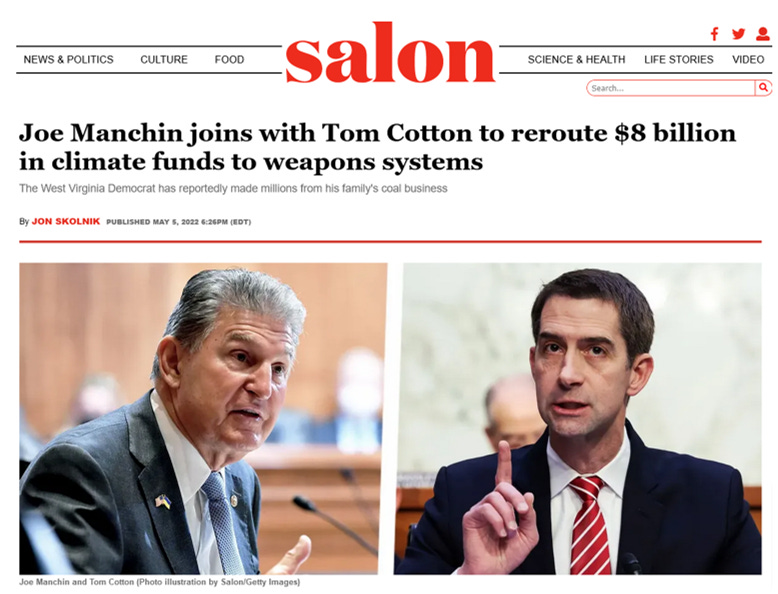
Manchin continued to obstruct climate policy throughout Biden’s term. He blocked progressive appointments to the Environmental Protection Agency (EPA) and co-sponsored legislation with Senator Tom Cotton to divert $8 billion from climate programs to weapons systems.
Conclusion
Both Democratic and Republican leaders remain deeply entangled with the fossil fuel industry. These ties have consistently undermined serious, sustained climate action. While Democrats have generally shown more openness to climate policy, their efforts have often been diluted by political calculations, industry influence, and internal divisions.
The bipartisan acceptance of fossil fuel money has helped entrench the status quo—delaying the urgent transition away from carbon-intensive energy and leaving the U.S. dangerously unprepared for the accelerating climate crisis.
The conditions we face today are not accidental. They are the outcome of deliberate choices made by powerful actors who prioritized profit, influence, and political convenience over the stability of the planet—and, by extension, over the future of human civilization and the survival of countless other species that share this Earth with us.
What happens next will not be determined by a lack of technology or scientific understanding—we have both. It will be determined by power, and by who is willing to wield it. Fossil fuel interests still dominate policymaking, shape media narratives, and flood electoral politics with money. Breaking their grip is not a matter of moral persuasion; it is a matter of political confrontation with systems designed to protect their dominance.
Incrementalism is no longer a viable path. The scale of change now required demands the dismantling of the fossil fuel industry and its enablers: the pay-to-play political system and the outdated economic ideologies that justify ecological destruction in the name of growth.
The future will not be shaped by those who led us into this mess. It must be seized by those with the courage to challenge them—now.