


Food security is often discussed in terms of income, markets, trade, and technology. But at its core, it depends on something more fundamental: living, functioning land. Without healthy soil, proper water regulation, and biodiversity, food systems cannot remain productive or resilient.
Productive soils store nutrients, retain moisture, and support the microorganisms that make agriculture possible. Grasslands regulate water flow, forests protect watersheds, and wetlands filter water supplies. Together, these systems create the environmental conditions that allow food production to continue.
Yet land everywhere is under growing strain. Agriculture already occupies about 40 percent of Earth’s land surface, and a significant share of that land — roughly one-third — shows signs of degradation. Each year, an estimated 100 million hectares (about 250 million acres) of land — an area twice the size of Spain — becomes degraded due to overgrazing, erosion, deforestation, unsustainable farming, water overuse, and urban expansion.
As soils degrade, they hold less water and fewer nutrients. Crops become more vulnerable to droughts, floods, and pests. Yields decline or become less reliable.
Land degradation does more than reduce harvests in a single season — it increases long-term food insecurity. Poor soils are less able to buffer extreme weather. During droughts, degraded land dries out quickly. During heavy rains, it erodes and washes away. This instability threatens the livelihoods of nearly 1.3 billion people employed in agriculture and the well-being of three times as many others whose households depend on agricultural systems, according to the UN Food and Agriculture Organization.
Degraded soils also increase pressure to clear new land, often at the expense of forests and natural habitats that act as carbon sinks. At the same time, degraded land stores less carbon, contributing to climate change, which further disrupts rainfall patterns and growing conditions. The result is a reinforcing cycle: damaged land contributes to climate stress, and climate stress makes food production even more difficult.
These challenges are intensifying as the global population grows. Feeding an additional two billion people by 2050 may require increasing food production by about 50 percent. Yet expanding agriculture into new areas is not only environmentally costly but also not always possible. Protecting and restoring existing farmland is therefore essential to future food security.
The good news is that land degradation can be reversed. Sustainable farming approaches focus on restoring the land’s natural functions. Crop rotation helps maintain soil nutrients and reduce pests. Cover crops protect soil from erosion and add organic matter. Reduced tillage preserves soil structure and moisture. Compost and manure replenish fertility. Improved grazing management allows grasslands to recover. Efficient irrigation conserves scarce water resources.
These practices do more than protect the environment — they stabilize yields. Healthier soils absorb and store water, helping crops survive dry periods. They drain better during heavy rains, reducing flood damage. They support beneficial organisms that naturally control pests. Over time, farms become less dependent on costly external inputs and more resilient to shocks.
A Lesson from the Sahel: Land Restoration in Practice
In some of the world’s most climate-stressed regions, farmers are already demonstrating how rebuilding soil can directly strengthen food security.
The Sahel region of Africa — a semi-arid belt stretching from the Atlantic Ocean to the Red Sea — is one such region, where the traditional Zaï technique has helped communities revive degraded fields.
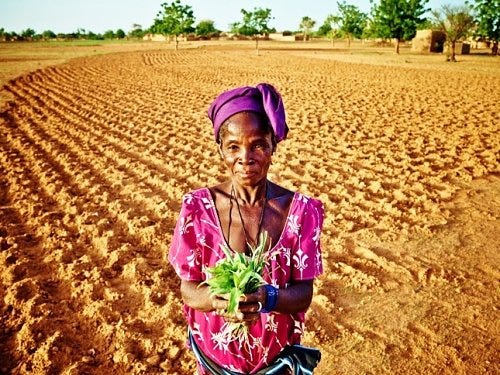
The Zaï technique involves farmers digging small pits in hardened soil and filling them with organic matter. These pits capture rainfall and concentrate nutrients where crops or trees are planted. Termites attracted to the organic material help break up compacted soil by digging tunnels, improving infiltration and aeration. Land that once produced little can gradually support crops and trees again.
The impact goes beyond individual fields. As soil fertility and vegetation return, communities see more stable harvests, improved water retention across the landscape, and greater resilience during droughts.
Building on approaches like Zaï, a large-scale restoration effort called the Great Green Wall was launched in 2007 by the African Union. The initiative aims to restore degraded land across the Sahel, combat climate change and biodiversity loss, create jobs, and strengthen community resilience. Since its launch, millions of hectares of degraded land have been restored, helping slow the spread of the Sahara.
This regional experience reflects an undeniable fact: restoring soil health strengthens the very foundation on which food security depends.
The living, functioning land
Protecting and restoring land means valuing soil as a living system rather than an expendable resource. It means preventing degradation where possible and restoring land where damage has already occurred. From large-scale policies to farm-level practices, every effort to rebuild soil fertility, conserve water, and protect ecosystems strengthens the foundation of food security.
In the end, ensuring that future generations have enough to eat begins with caring for the ground beneath our feet.
Thankyou ✨