


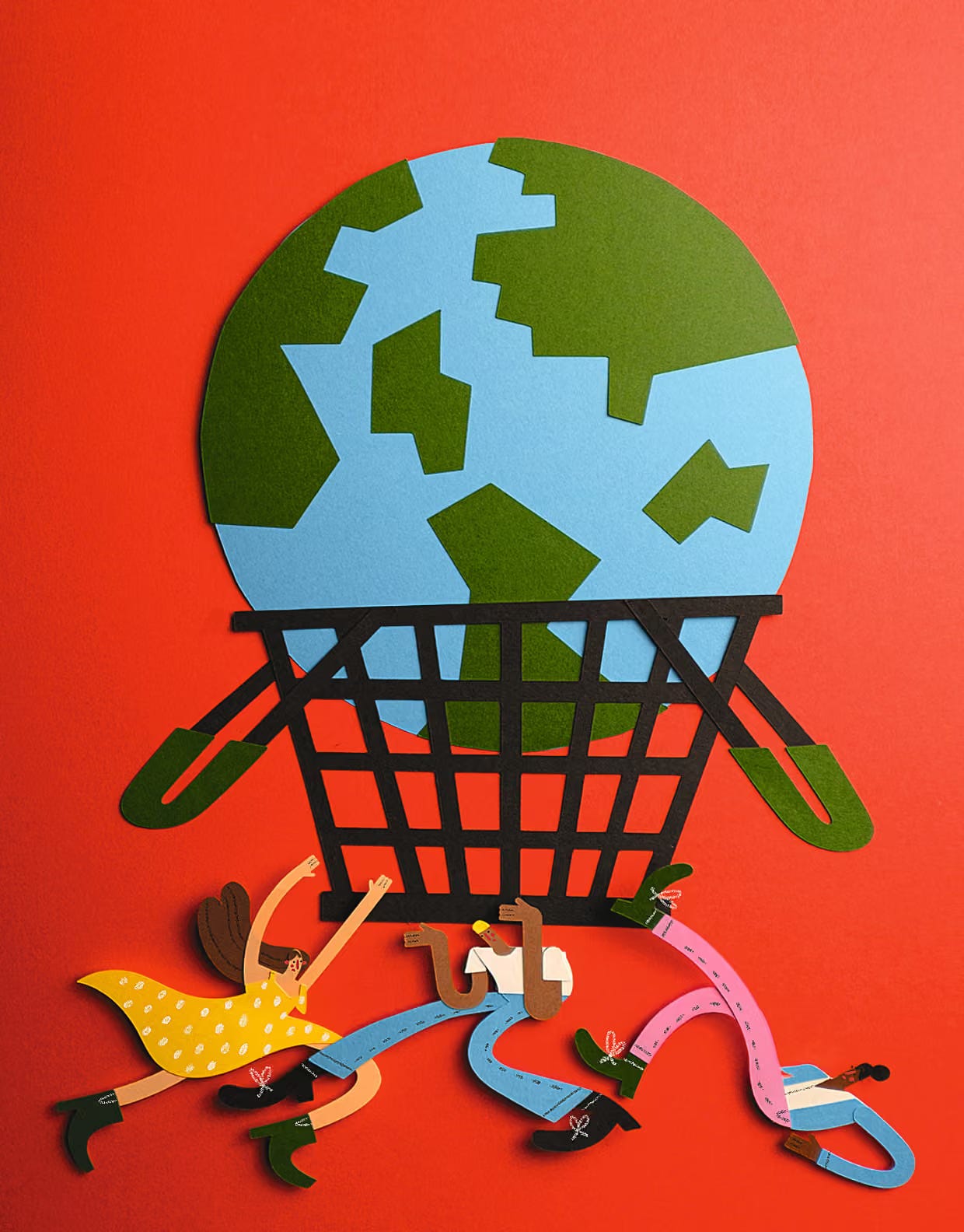
Credit: The Gaurdian
The difference between consumption and consumerism comes down to necessities versus manufactured “needs.”
Consumption
Consumption is the purchase and use of goods and services to meet basic needs. It is a normal and unavoidable part of life. Every person in every society consumes resources in order to survive and function.
People need food, shelter, utilities such as electricity and water, clothing, and transportation. These necessities allow us to work, learn, care for our families, and participate in society. Public investment in meeting these needs contributes to overall well-being: healthy populations tend to live longer and more productive lives, while educated populations generally earn more and enjoy a higher standard of living.
Consumerism
Consumerism, by contrast, is based on manufactured “needs.” It is a social and economic mindset—reinforced by constant advertising—that encourages the continual purchase and accumulation of goods far beyond what is necessary.
Consumerism promotes the idea that greater consumption leads to greater happiness or social status. It also supports an economic system that depends on continuously increasing consumption to generate profits. As a result, people are encouraged to seek satisfaction through constantly upgrading, replacing, and acquiring more possessions.
Why This Distinction Matters
Understanding the difference between consumption and consumerism is important when discussing sustainability.
Consumption is unavoidable because it meets essential human needs. Its environmental impact can remain relatively limited when goods are used responsibly and for long periods of time. For example, buying a car because no other transportation is available and then using it for many years places far less strain on the environment than replacing it every few years. Manufacturing new vehicles requires additional mining, energy, transportation, and industrial production, all of which increase emissions and resource extraction.
Consumerism, however, drives overconsumption. Overconsumption depletes natural resources, increases pollution, and accelerates climate change. It is especially common in affluent societies, where corporations often rely on low-paid labor in poorer countries to extract raw materials and manufacture inexpensive goods for global markets. Since the 1990s, this pattern has contributed to accelerated rise in emissions, worsening environmental damage, and persistent global inequality—including widespread hunger despite historically high levels of production.
In short, consumption sustains life and is unavoidable; consumerism encourages excess, often at significant social and environmental cost.
What Can Individuals Do?
Reducing overconsumption does not require eliminating consumption altogether. Instead, it means becoming more intentional about what we buy and why we buy it.
Some practical steps include:
Install browser extensions that block advertisements. For example, uBlock Origin removes many online ads and tracking systems.
Unsubscribe from promotional emails and avoid following influencers whose content encourages constant purchasing.
Limit time spent browsing retail websites or watching content designed to create the desire to upgrade or replace products.
Before buying non-essential items, wait several days—or even a month—to reduce impulse purchases. If the item still seems necessary after that time, consider whether it can be acquired in a more sustainable way