


There is nothing “light” about “light trucks,” except perhaps some of their color options. The category includes many of the largest and most polluting vehicles on the road: SUVs, pickups, crossovers, and vans.
As noted in Part 1, the rise of these vehicles was not simply the result of organic consumer demand. Their entrance into the market was shaped by government policy and effective marketing.
Facing mounting pressure from new federal fuel-efficiency standards and intensifying competition from more efficient imports, Detroit automakers—with tacit federal approval—found a workaround. They created a new class of vehicles by placing car-like bodies on truck frames.
Marketed as SUVs, these vehicles were classified as “light trucks,” which allowed manufacturers to meet the less stringent fuel-economy standards originally intended for work vehicles used by farmers and contractors. At the same time, they were skillfully positioned to appeal to consumers’ preference for buying American-made products and to a cultivated sense of frontier adventure.
The strategy worked. Today, light trucks account for roughly two-thirds of vehicles on U.S. roads and between 75% and 80% of new vehicle sales.
But this shift has profoundly reshaped the climate footprint of American transportation.
“Light trucks” are not light on the climate for several reasons:
1. They Burn More Fuel
Transportation is the largest source of greenhouse gas emissions in the United States, and passenger vehicles make up most of that total. When the vehicle fleet shifts toward heavier, less fuel-efficient models, overall emissions rise—even if engines become incrementally more efficient.
In 2022, light trucks accounted for roughly 37% of U.S. transportation greenhouse gas emissions—the single largest share within the sector and 14% of total national emissions. While sedans deliver 30 to 40+ MPG., SUVs and crossovers typically achieve between 25 and 34 miles per gallon (MPG) and pickup trucks average between 15 and 25 MPG.
The global implications are even more striking. Between 2010 and 2018, SUVs alone were the second-largest contributor to the growth in global carbon emissions—surpassed only by the power sector and exceeding emissions growth from heavy industry.
2. Manufacturing Emissions Are Higher
Bigger vehicles require more steel, more aluminum, larger engines, and more energy-intensive manufacturing processes.
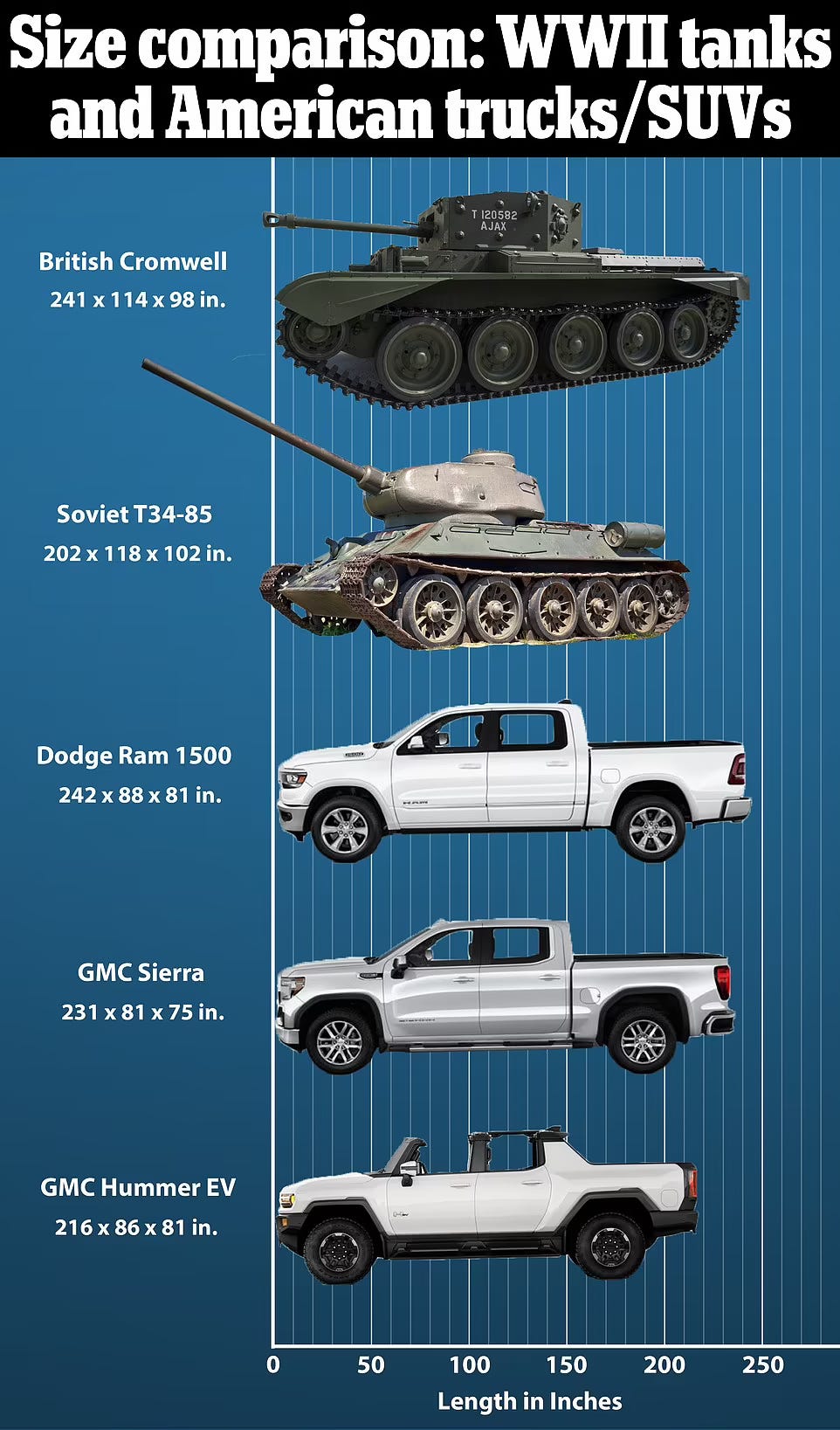
Over the past three to four decades, both SUVs and pickup trucks have grown substantially in size. Many SUV models have added more than 10 inches in length and have become significantly wider. Modern full-size pickup trucks have expanded dramatically—some models are over five feet longer, 20 inches wider, and 10 inches taller than their earlier counterparts.
Since 1990, the average pickup truck’s weight has increased by roughly 32% (about 1,300 pounds). Some high-end models now weigh as much as three small cars combined.
In terms of sheer size and weight, today’s SUVs and pickups rival some armored vehicles of earlier eras. The material and energy inputs required to manufacture them are correspondingly larger.
3. They Lock In Long-Term Emissions
Vehicle turnover is slow. The average age of pickup trucks and SUVs on U.S. roads is approximately 12.5 years. When millions of consumers purchase larger, less fuel-efficient vehicles, the associated emissions are effectively locked in for more than a decade, delaying progress toward climate targets.
In short, the “light truck” classification may have begun as a regulatory distinction. But its real-world consequences are nothing but light. The category now defines the American vehicle market—and plays a central role in shaping the nation’s climate trajectory.
How can we reduce the carbon footprint of the so called “light trucks?”
To start, don’t buy them! If you are looking to buy a new car, think of sedans and compacts. The reasons are simple.
One, these huge vehicles are not necessarily safer than sedans or compact cars. They are more likely to roll over or crash into other cars because of their height, poorer maneuverability, and larger blind spots.
Two, SUVs and pickups are more likely to injure or kill pedestrians and occupants in sedans or compact cars due to their height, size, and weight.
Three, if you are one of the majority of pickup trucks and SUV owners who never use your vehicle to climb rough trains or haul cargo, you should know that according to Consumer Reports you can buy a high-end luxury sedan for the same price as a large luxury SUV or pickup truck -$60,000 to $100,000- and enjoy superior performance, comfort, and, in many cases, more advanced technology features.
Don’t fall for the electric versions of SUVs and pickup trucks either. They have the same problems associated with safety and value in addition to a few more. Their manufacturing produces more CO2 than internal combustion engines. Since the electric grid relies mostly on fossil fuels, you will continue to add greenhouse gas emissions to the atmosphere. Extracting lithium and cobalt involves violations of human rights such as the right to water, labor safety, and fair compensation.
The good news is that the present system was engineered and therefore it can be re-engineered. In part three we will look at how consumers can help re-engineer the transportation system.